

Letters in Solidarity: The Courage to Care
The Courage to Care
Holding Care for Our Children, Families, Communities, One Another, and Ourselves
Dear SDEA Family,
Somewhere today, an educator noticed something was different about a child.
Maybe it was the way they walked into the room. The smile that wasn't there. The unusually quiet voice. Or the way they lingered just a little longer before taking their seat.
Nothing extraordinary happened. There was no announcement, no meeting, no recognition.
Just an adult who noticed.
And a child who, perhaps for the first time that day, felt seen.
I wonder how many moments like that happen in our schools every day.
The teacher who stays a few minutes to listen. The counselor who makes room for one more conversation. The paraeducator who recognizes that a student is becoming overwhelmed before anyone else notices. The colleague who quietly checks on another colleague because something doesn't seem right.
So much of what makes a school a community happens in moments nobody records.
And yet, those moments can change someone's entire day.
Sometimes, even their life.
I've been thinking about that kind of care lately. The kind that isn't written into a lesson plan or measured on an evaluation. The kind that asks us to pay attention, to remain curious, and to remember that the person in front of us has a life we may know very little about.
Especially now.
Because there is a heaviness in our world that does not disappear when the school bell rings.
Children hear things. They notice when the adults they love are worried. They sense when something has changed at home, in their neighborhood, or in the world around them.
Some are carrying fears about whether their families will remain together. Some are grieving. Some are struggling to belong. Others are simply trying to understand a world that can be confusing, unkind, and frightening.
And many are carrying things they have never told us.
As educators, we cannot fix everything happening in their lives.
But we can decide what happens when they walk through our doors.
We can decide whether they encounter another person who judges them before knowing them, or someone willing to see beyond what is immediately visible.
After more than two decades as an educator, much of that time working with students with disabilities, I have learned that some of the most important things we do begin with what we are willing to notice.
A change in behavior. A look of frustration. A student who has stopped trying. A child who needs someone to believe there is more to them than the difficulty they are experiencing.
And as a mother and now a Gigi, I understand that from another side of the classroom door.
I know what it means to love a child so deeply that you wish you could protect them from every hurt the world might bring. To trust that when they are beyond your reach, someone else will recognize their worth.
It is a tremendous act of trust to place someone you love in the care of another person.
And every day, families place that trust in us.
Before a child is a student, they are a human being.
Before the IEP, the test score, the behavior referral, the attendance record, or the label someone has attached to them, there is a child with a story still being written.
And we get to be part of that story.
What an extraordinary responsibility.
What an extraordinary privilege.
I also know how difficult it can be to hold onto that perspective when we're exhausted, overwhelmed, understaffed, or trying to meet more needs than any one person reasonably can.
There are days when patience feels harder to find. When the student who needs the most attention arrives at the very moment we have the least to give.
Those are human moments, too.
We don't always respond the way we wish we had.
I certainly haven't gotten every moment right.
But I hope we never lose the willingness to ask ourselves whether we saw the whole child or only the behavior in front of us.
Whether we made room for dignity while holding expectations.
Whether the child left our care feeling smaller or feeling that tomorrow could be different.
And when we realize we missed something, I hope we give ourselves the opportunity to make it right.
That matters.
So does the way we see families.
I think sometimes we forget how vulnerable it can feel to be on the other side of a conversation about your child.
The parent who seems frustrated may be frightened. The caregiver who keeps asking questions may be searching for reassurance. The family who missed the meeting may be managing circumstances we know nothing about.
And sometimes families have been hurt by the very institutions we are asking them to trust.
That history doesn't disappear simply because we have good intentions.
We may not always agree. There will be difficult conversations, and there should be. Our professional responsibilities matter, and so does our right to be treated with respect.
But I hope we can approach families remembering that love doesn't always sound calm, fear doesn't always look like fear, and frustration is not always a rejection of partnership.
Sometimes people need to know we are listening before they can hear anything we have to say.
And sometimes we need to hear something uncomfortable before we understand what they have been trying to tell us.
The same is true of our communities.
I've been thinking about the families living with uncertainty and fear right now. About children hearing people speak of their neighborhoods, their identities, and the people they love as though their suffering is somehow acceptable.
I wonder what it feels like for a child to hear the place they call home spoken about with contempt.
Or to wonder whether the adults around them believe their family belongs.
Our schools are part of those communities. Their joys, fears, histories, struggles, and hopes are woven into the lives of the children we teach.
We cannot separate the child from the world they live in.
And we should never ask a child to leave their humanity at the classroom door.
This week has reminded me how quickly words spoken far from a classroom can find their way into one.
A child may not understand every political debate or policy decision, but they recognize when something feels uncertain at home. They notice conversations that stop when they enter a room. They hear the worry in a parent's voice. They sense when the adults they depend on are carrying something difficult, even when they don't fully understand what it is.
And I think about the educators trying to find the right words when a child asks a question they cannot easily answer.
Sometimes there are no perfect words.
Sometimes all we can offer in that moment is our presence, our willingness to listen, and the reassurance that the child in front of us matters.
That matters more than we may ever know.
And while we cannot promise that everything outside our school doors will be okay, we can work together to make sure that inside them, every child is treated with dignity, every family is welcomed with respect, and no one is made to feel that their humanity is up for debate.
Care, in moments like these, may require courage.
The courage to speak when something is wrong. To stand beside a family when they feel alone. To challenge decisions that harm people. To recognize that we can disagree deeply with someone's choices while still refusing to strip them of their humanity.
Caring does not mean accepting injustice.
It does not mean pretending harm hasn't happened.
And it certainly does not mean that accountability disappears.
Sometimes the most caring thing we can do is tell the truth, even when the truth makes people uncomfortable.
But how we tell that truth matters, too.
I want us to be people who can stand firmly in our convictions without forgetting the human beings standing across from us.
And I want us to extend that care to the people standing beside us.
Because I know our schools are filled with people carrying things we cannot see.
The new educator wondering whether they're good enough.
The experienced teacher who still loves teaching but is tired of everything surrounding it.
The Special Education teacher trying to meet the needs of every student while navigating responsibilities that never seem to end.
The paraeducator whose relationship with a child has become a source of safety and trust.
The counselor or mental health provider who carries difficult stories home.
The classified union sibling whose work is essential to the life of the school.
The colleague who has become quieter lately.
The person who always says they're fine.
Maybe they are.
Maybe they aren't.
And maybe we won't know unless we ask.
Not every difficult relationship can be repaired with kindness. Some situations require boundaries, intervention, accountability, and meaningful change. I believe that deeply.
But I also believe we can become so accustomed to managing our own pressures that we forget the person beside us may be doing the same.
We do not have to understand every part of someone's experience to care about what happens to them.
We do not have to share a job title, a bargaining unit, or even the same perspective to recognize that their dignity matters.
And when our labor siblings are fighting for the respect, safety, and working conditions they deserve, their struggle should matter to us.
Because care that only extends as far as our own interests is too small for the communities we are trying to build.
There is another part of this conversation I don't want us to overlook.
Us.
The people doing the caring.
I wonder how many educators are reading this after a day when they gave everything they had and still went home thinking about what they didn't get done.
How many are worried about a student right now.
How many are trying to be present for their own children, partners, parents, or families while their minds are still somewhere at school.
How many are carrying grief, financial worries, health concerns, or responsibilities that nobody at work knows about.
And how many have become so good at being the person everyone depends on that they've forgotten what it feels like to be cared for themselves.
I understand that more than I sometimes want to admit.
I know how easy it is to encourage someone else to rest while convincing ourselves that we have just one more thing to finish.
One more call.
One more problem to solve.
One more person who needs us.
And I am learning that there will always be one more thing.
Our humanity does not disappear because we chose a profession rooted in service.
We deserve tenderness, too.
We deserve patience when we're struggling, space to grieve when we're hurting, and permission to experience joy without feeling guilty about the work waiting for us.
We deserve to have lives beyond our jobs.
And we deserve working conditions that make those lives possible.
Because I am not going to tell an exhausted educator that the solution is simply to take a bubble bath, practice mindfulness, or find a better way to manage their time.
Rest matters. Boundaries matter. Mental health matters.
But no amount of individual self-care can compensate for a system that continually asks people to give more than they have.
We need adequate staffing. Manageable workloads. Safe schools. Respect for our professional judgment. Time to do our work well. And systems that support the people who support our children.
That is part of what we fight for as a union.
Not just a better contract, but the conditions that allow educators and students to flourish.
We cannot build schools rooted in care while treating the well-being of the people inside them as an afterthought.
And we cannot expect educators to carry that responsibility alone.
I think about what becomes possible when care is shared.
When a colleague notices someone struggling and offers support.
When a family feels comfortable enough to tell us what they really need.
When a student knows that making a mistake will not cost them their dignity.
When our union siblings know we will stand beside them, even when their struggle is not our own.
When we are willing to ask for help and know that doing so will not be mistaken for weakness.
Those may sound like small things.
But I have come to believe that some of the biggest changes begin with the smallest decisions we make about how we treat one another.
I don't expect us to get everything right.
I know I won't.
There will be days when we are tired, impatient, distracted, or overwhelmed. Days when we miss something important or wish we could take back what we said.
But there will also be another opportunity to listen. Another chance to apologize. Another moment to notice someone we overlooked.
And there will be opportunities to laugh, celebrate, find joy, and remember that our lives are so much bigger than the challenges in front of us.
I want that for us.
I want our children to experience schools where they are loved, valued, accepted, challenged, and understood.
I want families to know they are welcomed as partners, not treated as problems to manage.
I want our communities to know that we see their humanity and that their children are precious to us.
I want the people working in our schools to know that their contributions matter, whether or not anyone notices them.
And I want us to remember that we matter, too.
Not because of how much we accomplish.
Not because of how many people depend on us.
Not because we have managed to hold everything together.
Simply because we are human.
I still have tremendous hope for what we can build together.
Not because I believe the work will become easy, but because I know the extraordinary people doing it.
I've seen what happens when someone refuses to give up on a child.
I've seen families find their voices.
I've seen educators stand together when it would have been easier to look away.
And I've seen how one person choosing compassion can change the direction of someone else's day.
That is worth protecting.
That is worth building upon.
And that is worth fighting for.
Sometimes care is the very reason we fight.
So as we move through the days ahead, I hope we notice a little more. Listen a little longer. Extend a little more grace where it is needed, and find the courage to speak when something is wrong.
I hope we remember that the person in front of us has a story we may not know.
And I hope that when the person who needs compassion is the one looking back at us in the mirror, we offer it there, too.
Our children are counting on us.
But we are also counting on one another.
And I believe we can be there for each other.
With care. With courage. With humanity.
In Solidarity,
Monique Barrett, M.Ed.
President, San Diego Education Association
Until next time,
Take care of yourselves.
Take care of one another.
And please remember, you deserve to be cared for, too.
I'll see you out there.


Defending our Right to Organize
Protected union activity: The right underneath all the other rights
Our right to participate in our union is the foundation for so many of our other rights. It gives us the right to organize and solve problems together, negotiate better working and learning conditions, and stand up to bad bosses when needed. Not every unfair, inappropriate, or unprofessional leadership decision violates the law, but state law does protect us from retaliation for protected union activity. Without that protection, bad bosses can squash workers’ attempts to organize.
Recently, SDEA members used the legal process to challenge alleged retaliation and reaffirm our right to protected union activity.
The right to assign… and the right to organize
Principals have the right to assign educators to teaching positions that they are credentialed for. Ideally, principals make those decisions based on the school's needs and educators’ input… as educators, our assignments have a huge impact on our work and life! At Logan Memorial Educational Campus (LMEC), some SDEA members had concerns about how administrators assign teachers.
LMEC is unique in our district: It is an infant through 12th-grade campus that technically operates as one school or “educational complex.” With so many positions across a wide range of grade levels, administrators can move educators to dramatically different assignments if they have the relevant credential.
In recent years, SDEA members experienced administrators moving or threatening to move educators in ways that seemed arbitrary or extreme… for example, moving educators from secondary to elementary, to totally new content areas, or away from Special Education into general education and vice versa. Sometimes these moves came after educators filed grievances, spoke up together in staff meetings, or represented members as a union rep. In many cases, educators were not satisfied with vague explanations about the decisions not being “personal” and “coming from above.” Members raised concerns that assignments were being used to punish educators for union activity. Retaliation is hard to prove, especially in a big complex with lots of teacher moves and multiple grievances, but SDEA members organized to document patterns and connect the dots between union activity and reassignments. They brought that evidence to SDEA leaders and staff.
Union activity is protected by state law, not just our contract
Retaliation for union activity affects the whole union, and the rights of all workers! If one administrator is allowed to punish union reps or union members for standing up for their rights, all of our rights are weaker. SDEA leaders and staff helped members at LMEC review the conduct that they believed may have been retaliatory. They submitted formal requests for information from the District, looking for any evidence that these reassignments were for a reason other than retaliation - for example, documentation of other reasons to assign teachers to subjects they were credentialed for but that they did not want to teach or that they had limited experience in. SDEA members weren’t satisfied with the District’s responses, which they found incomplete and even incorrect regarding LMEC assignments. Without convincing evidence to the contrary, members still suspected that administrators were using assignments as retaliation for union activity, and filed an official Unfair Practice Charge with the state Public Employment Relations Board (PERB).
Unfair Practice Charges: Spotlighting Bad Boss Behavior
An Unfair Practice Charge is one tool that unions can use to shine a spotlight on alleged violations of labor law. When we file these charges, our union shares a summary of facts and any evidence we have about the unfair practice. Then the District can share any facts and evidence they have. Some charges go all the way to a public hearing, but sometimes the charge itself is enough to get results! In this case, PERB reviewed the charge and the evidence and issued a complaint. The District agreed to settle rather than have the charge go to a formal hearing. SDEA members used the settlement as an opportunity to reaffirm our rights! In order to settle the charge, the District agreed to send a letter to all LMEC educators about the unfair practice charge and reaffirm our right to protected union activity and to the information we need to investigate things that seem like retaliation.
That letter reaffirmed:
- Employees have the right to engage in concerted Union activity free from retaliation and interference.
- SDEA is entitled to information as relevant and necessary for the Union to discharge its representational duties under the EERA.
When union members see what looks like retaliation for union activity, that can have a chilling effect that makes it harder for workers to feel safe standing up for their rights. That’s why it’s important to send a countermessage: We do have rights, and we’re ready to fight for them!
How can you stand up for your rights?
- Talk to your union rep when issues come up! Look at the contract together to see if any of your contractual rights are being violated.
- Talk to your colleagues. Even when an issue isn’t a contract violation, workers have more power when they stand together and act collectively.
- Most importantly, organize! Grievances and unfair practice charges are important tools to enforce our rights, but legal processes can take time. Collective action can address problems before they escalate! Strategize with your union rep and colleagues about the best way to stand up for your rights together.
August 2026 SpEd Caseload Overage Payments (Appeal by Nov 12)
For caseload overages in August 2026, penalty payments should have been paid on the September payroll.
August 2026 SpEd Stipend Exhibit: Check the District’s data on your caseload and stipends owed.
August 2026 Appeals Form: See an error that would change your payment? Fill out an appeal form for the month the error occurred. Deadline: November 12, 2026 at 11:59 PM PST
Know Your Rights - Ed Specialist Caseload Penalty Payments:
Understand the penalty payments and process with this KYR flyer and on this web page.

Vote Union: November 3, 2026
Election day is coming up on November 3, 2026 - let your union help you with your democracy homework! Several items on your ballot will significantly affect public education, including our neighborhood schools in San Diego and schools throughout California. All registered voters should receive a ballot in the mail the week of October 5. See more information about this election and your voting options at sdvote.com.
SDEA’s endorsements:
Over the past months, SDEA members elected as site and program reps and to the Board of Directors have voted on a few specific endorsements. See more about the SDEA process for endorsements.
🍎 Vote YES on Measure A: A transparent, accountable, modern county government
This measure would make our county government more accountable to the community by adding an ethics committee, oversight of the budget and program results, and more accountability for senior leadership… all with no new spending or new taxes. Learn more at SDforaccountability.org.
🍎 Vote YES on Measure G: Bond Measure for Grossmont-Cuyamaca Community College District
This bond measure will be on the ballot for members in East County, and will repair and upgrade aging classrooms and educational facilities at Grossmont College and Cuyamaca College… without raising taxes! Learn more at EastCounty4Colleges.com.
🍎 Vote YES on Measure M: Urgently needed repairs for neighborhood schools without raising taxes! See more about this measure here and access the SDUSD resolution which details their proposed improvements across the District. (It’s a long document because it includes improvements at all sites across the District, but you can search for specific sites.) Our union contract gives us the right to safe, well-maintained schools. Our power as voters helps ensure that SDUSD has the bond funds needed to maintain and update our schools!
🍎 Vote for Hayden Gore for SDUSD School Board (District C)! Hayden is a full time teacher and is invested in union values - he and his colleagues unionized their entire charter network!
Vote Union, Up & Down Your Ballot:
While SDEA does not endorse in every race, see below for other labor endorsements, from CTA and from our local San Diego & Imperial Counties Labor Council. (Note that depending on where you live, not everything on this list will be on your ballot. If you live outside the City of San Diego you might want to check out the full list of endorsements from Labor Council.)

Legend:
- 🍎 Endorsed by SDEA (See above)
- 🔵 Endorsed by CTA (See more information about their recommendations, including recommendations based on exactly who will be on your ballot)
- ✊ Endorsed by San Diego & Imperial Counties Labor Council (See more about their endorsements)
Statewide:
- Governor: Xavier Becerra 🔵✊
- Lt. Governor: Fiona Ma 🔵✊
- Secretary of State: Dr. Shirley Weber 🔵✊
- CA Controller: Malia Cohen 🔵✊
- CA Treasurer: Eleni Kounalakis 🔵✊
- Attorney General: Rob Bonta 🔵✊
- Insurance Commissioner: Jane Kim 🔵✊
- Board of Equalization - District 1: Nelson Esparza 🔵
- Board of Equalization - District 2: Sally Lieber 🔵
- Board of Equalization - District 3: Mike Gipson 🔵
- Board of Equalization - District 4: Tom Umberg 🔵✊
- US Congress - House of Representatives - District 25: Raul Ruiz 🔵✊
- US Congress - House of Representatives - District 48: Marni von Wilpert 🔵✊
- US Congress - House of Representatives - District 49: Mike Levin 🔵✊
- US Congress - House of Representatives - District 50: Scott Peters 🔵✊
- US Congress - House of Representatives - District 51: Sara Jacobs 🔵✊
- US Congress - House of Representatives - District 52: Juan Vargas ✊
- CA State Assembly - District 74: Sergio Farias 🔵
- CA State Assembly - District 76: Dr. Darshana Patel 🔵✊
- CA State Assembly - District 77: Tasha Boerner 🔵✊
- CA State Assembly - District 78: Chris Ward 🔵✊
- CA State Assembly - District 79: Dr. LaShae Sharp-Collins 🔵✊
- CA State Assembly - District 80: David Alvarez 🔵
- CA State Senate - District 18: Steve Padilla 🔵✊
- CA State Senate - District 38: Catherine Blakespear 🔵✊
- CA State Senate - District 40: Mara Elliott 🔵✊
- YES on Prop 1 (Veterans and Affordable Housing Bond Act) ✊
- YES on Prop 2 (Increases State’s Rainy Day Fund) ✊
- YES on Prop 3 (Protect our Schools & Healthcare) 🔵✊
- YES on Prop 4 (Repeals Ban on Public Funding of Election Campaigns) ✊
- YES on Prop 5 (Changes Recall Election Process for Statewide Officers) ✊
- YES on Prop 37 (Loan Program for Middle-Income New Home Buyers) 🔵✊
- NO on Prop 39 (Protect our voice, protect our vote) 🔵✊
- NO on Prop 40 (One-Time Billionaire Tax leaves out education, housing and safety.) 🔵
- NO on Prop 41 (Requires Audits for New State Special Taxes) ✊
- NO on Prop 42 (Prohibits New State Personal Property Taxes) ✊
- NO on Prop 43 (Limits Voters’ Ability to Raise Revenues for Local Services) 🔵✊
- NO on Prop 44 (Stop the attack on patients & clinics) 🔵
- NO on Prop 45 (Limits CEQA Environmental Review and Public Input) ✊
School:
- State Superintendent of Public Instruction: Richard Barrera 🔵✊
- San Diego County Board of Education - 3: Alicia Muñoz ✊
- San Diego County Board of Education - 5: Rick Shea ✊
- San Diego Unified School District Board of Education District C: Hayden Gore 🍎✊
- San Diego Community College District - A: Maria Senour ✊
- San Diego Community College District - C: Craig Milgrim ✊
- San Diego Community College District - E: Geysil Arroyo ✊
San Diego County:
- Board of Supervisors - District 4: Monica Montgomery Steppe ✊
- Board of Supervisors - District 5: Kyle Krahel ✊
- Treasurer-Tax Collector: Larry Cohen ✊
- Valle De Oro Community Planning: Jay Steiger ✊
- YES on Measure A (A transparent, accountable, modern county government) 🍎✊
- YES on Measure B (Fund San Diego County Health and Social Services) ✊
City of San Diego:
- City Council - District 2: Nicole Crosby ✊
- City Council - District 4: Henry Foster III ✊
- City Council - District 6: Kent Lee ✊
- City Council - District 8: Antonio Martinez ✊
- YES on Measure M (Repairs for Neighborhood Schools Without Raising Taxes) 🍎✊
Grossmont-Cuyamaca Community College District:
- YES on Measure G (Bond Measure for Grossmont-Cuyamaca Community College District) 🍎✊
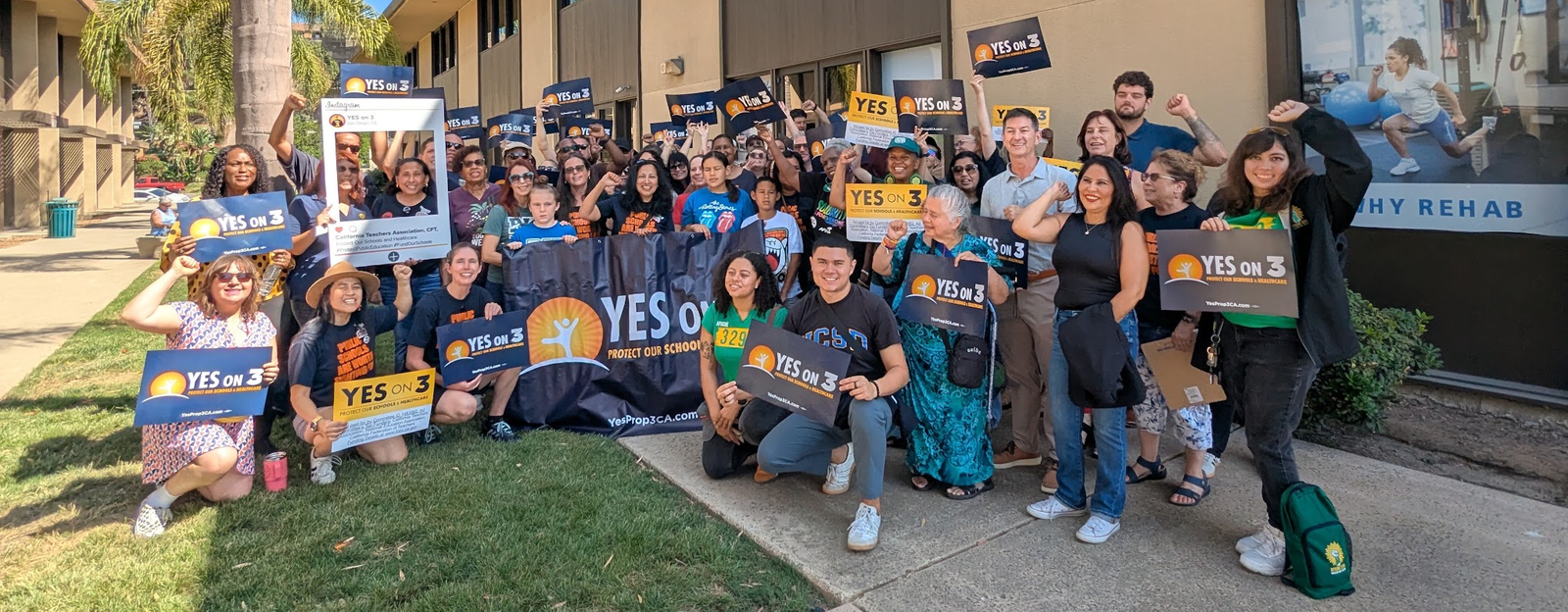
Get out the vote!
Voters listen to educators, and educators across California are knocking on doors to make sure our communities understand what’s at stake. This election includes votes that can make or break our schools!
Sign up to canvass in your community any weekend (or every weekend!) until Election Day:
- East County: El Cajon, Lakeside, or Santee
- South Bay: Chula Vista, Imperial Beach, or National City
- North County: Oceanside, San Marcos, or Temecula
More resources to get the message out:
- Spread the word about why school funding matters to YOU by recording a video
- More resources from CTA

Spread the word: YES on 3!
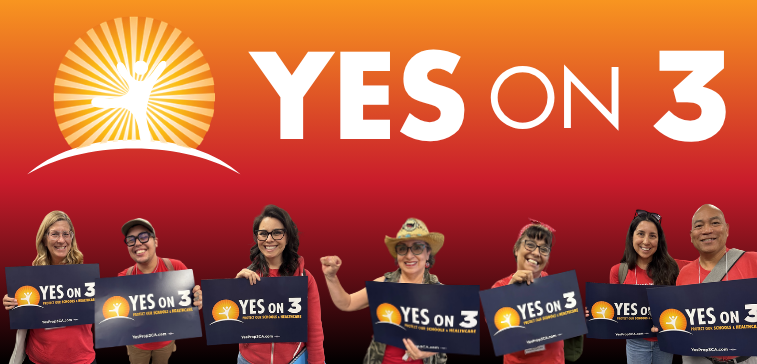
This November, California voters have an opportunity to protect school funding. Proposition 3 would make permanent the tax on the wealthiest Californians. For 15 years, that tax has funded smaller class sizes, school lunches, mental health supports, and Medi-Cal coverage for millions of families, but it expires in 2030. If we don't pass Proposition 3 this November, we'll lose that funding... triggering massive cuts and layoffs for 1 in 6 educators statewide. Our communities need to hear from trusted educators like us… because when teachers talk about what schools need, voters listen! Our wealthy state can afford to fund public education. Our students can’t afford the cuts if we don’t.
Spread the word: Canvass in your community!
- East County: El Cajon, Lakeside, or Santee
- South Bay: Chula Vista, Imperial Beach, or National City
- North County: Oceanside, San Marcos, or Temecula
More resources to get the message out:
- Spread the word about why this school funding matters to YOU by recording a video
- Join a 30-minute messaging workshop to feel more confident about how to talk about school funding with your communities
- More resources from CTA!
Statement - October 6, 2026
Statment - October 6, 2026
San Diego Education Association represents over 6,500 educators. We are done being polite about this.
When national rhetoric treats San Diego as a punchline, it does not stay on a stage. It walks straight into our classrooms. Our educators spent this morning sitting with young students who heard their home mocked on national television, answering questions no child should have to ask, and holding their own fear quietly so a room full of kids could feel safe.
That is not in any job description. Nobody pays our educators enough to carry that weight. They do it anyway, because that is what showing up for this community looks like.
More than 115,000 active-duty military personnel call this region home. They are the parents of the children sitting in our classrooms. San Diego has paid real prices in service to this country. Nobody gets to call that small. Nobody gets to call it a joke.
San Diego Education Association will not sit quietly while political theater puts fear in our students and extra weight on the educators holding them steady. Our members show up for our communities every single day. We expect the same respect in return, and we will keep saying it until somebody listens.
Children at the Heart. Educators at the Center. Justice at the Core.
Monique Barrett
President, San Diego Education Association
CalVEBA Health Fair: Oct 14
CalVEBA has a variety of health fairs for free health screenings and more - see more here here!
*Looking for ways to connect, give back, and support wellness in our San Diego Unified community? Be sure to stop by the Community Service Association (CSA) table at an upcoming Health Fair, or email csa@sandi.net!

Retirement Workshops
No matter where you are in your career, it’s never too late to think about your retirement benefits. CTA has a several virtual workshops available to get the facts on retirement options, your pension formula, and more. Sign up today!

Fright for Future
 For the past 5 years, Fright for Future has been a creative way to educate young people and the wider community about the “true terrors” in San Diego... the scary issues that impact people, planet, and animals, and how our actions can make an impact! This maze is in partnership with several local organizations including SanDiego350, the event's fiscal sponsor.
There are 20 haunted attractions within the maze that are both scary and educational - check them out to see some examples of the issues and information that this exhibit shares.
Options for educators:
1. Bring your students through the maze during the school day (Oct 12-16 & Oct 19-23 from 9am - 2pm) at 37ECB (3720 El Cajon Blvd, San Diego, CA 92105). Reach out to frightforfuturehaunt@gmail.com to coordinate!
OR
2. Share with your students to attend on the weekend of Oct 16-18 & Oct 23-25 for free as an extra credit opportunity.
2025 Fright for Future Testimonial from a middle school science teacher:
Sept 19 Day of Action: YES on 3!
This Fall, educators across California are knocking on doors & talking to our neighbors about Proposition 3 & how OUR vote can save OUR public schools!
September 19: Day of Action!

Here in San Diego, gather with educators & community allies, then head out to canvass together. (First time canvassing? Don't worry - training is included, and you won't be alone!)
🗓️ September 19, 2026
⏰ 10:00 AM - 1:00 PM
📍 SDEA Union Hall
✊ Special Guests include David Goldberg (CTA President) & Liz Ortega (Assemblymember & Chair of Labor Committee)
🔗 RSVP using this link!
📣 Bring your colleagues, friends, & family! Spread the word by sharing a flyer or resharing social media posts on Facebook, Instagram, & BlueSky
Sign up to canvass in your community:
Even if you can't make it on Sept 19, we'll be canvassing every weekend until Election Day! Sign up to talk to your community:
- Central San Diego: From the SDEA Union Hall!
- East County: El Cajon, Lakeside, or Santee
- South Bay: Chula Vista, Imperial Beach, or National City
- North County: Oceanside, San Marcos, or Temecula
More resources to get the message out:
- Spread the word about why this school funding matters to YOU by recording a video
- Join a 30-minute messaging workshop to feel more confident about how to talk about school funding with your communities
- More resources from CTA!